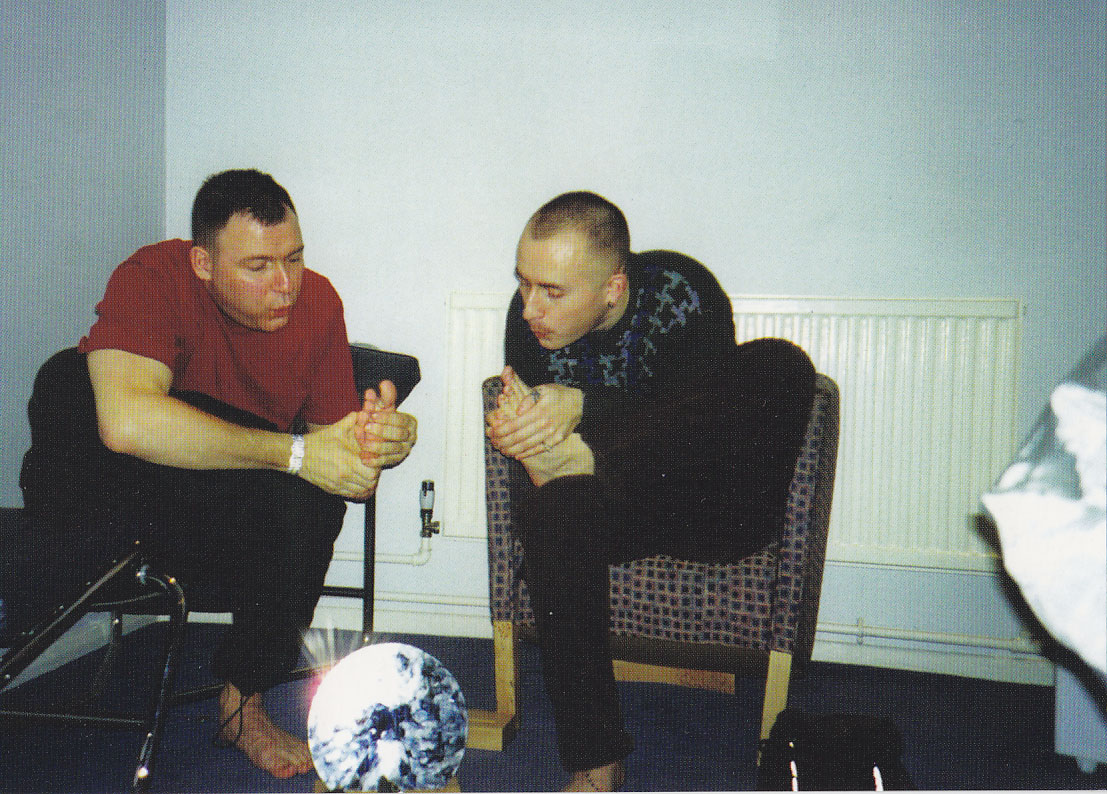
Monday, 9 August 2010

Coil - Colour Sound Oblivion: Disc 2: Sonar Festival, Barcelona, 2000


Coil: Colour Sound Oblivion: Disc 2

June 17th, 2000
Coil: Sonar Festival, Barcelona

Personnel

John Balance
Peter Christopherson
Thighpaulsandra
Ossian Brown

Bill Breeze (Viola)

Feeling: Fluffy

Tracklisting:

Everything Keeps Dissolving

Amethyst Deceivers

Circulating

The Universe is a Haunted House/Chasms

Elves


I was fortunate enough to see Coil play twice, both in 2000. The first time I saw them was their first proper concert performance at the Royal Festival Hall as part of Julian Cope’s Cornucopia programme, performed just over two months before the Sonar performance captured on this disc. This was a perfomance intially billed as The Industrial use of Semen Will Revolutionise the Human Race.The anticipation around Coil’s first London performance was immense, matched only by the speculation surrounding their likely setlist and stage appearance. I remember that I was initially quite startled when Coil came on stage, bathed in a deep purple light, as a four-piece clad in hooded white fluffy costumes covered with miniature mirrors, to take up their places at assigned synthesiser stations in front of a backdrop bearing the John Dee Monad from their 1998 Time Machines album.


They proceeded to perform a relatively ‘short’ set, lasting a mere 40 minutes; yet they played three of the most intense, dynamic and astonishing electronic drones I’d ever heard live. But what I also found striking was their overall stage presence throughout their brief performance; there was an overwhelming sense of them performing a predetermined and highly focussed ritual composed of slow and deliberate movements. I remember being struck by the careful and controlled movement of the four members on stage, it seemed highly choreographed and intentional, compromised of slow synchronised movements and pre-established routines around the stage. Visually it seemed to have the same aura and power as Beckett’s late stage masterpiece Quad.


Coil presented themselves as mysteriously coordinated figures, all clad in identical costumes, tracing out a hidden geometry as if in another dimension than that of the real. Their music suggested an inexorable descent through some kind of fabulous portal akin to the journey undertaken by Bowman during the extraordinary psychedelic sequence in Kubrick’s 2001: A Space Odyssey. This seemed like a journey in both inner and outer space, as well as being a journey in time. The three pieces of music played that night managed to elaborate very powerful dynamics whilst appearing largely static. This was an experiment in altering our perception of time, and to be an extension to the work previously undertaken in the studio on Time Machines. The performative ritual accompanying this music only added to the sense of a strange elongation of time - slow and careful repetitions across the stage, minimal interactions between the four, indiscernible manipulation of mirrors, crystals, incense, wands, etc, all designed to provide the audience with a very powerful transcendent and magickal experience. The final piece, Chasms, presented a vast backdrop of electronic drones which were punctuated by the most enormous and resonant slabs of electronic sound and Balance intoning as if from another dimension the Crowleyean dictum ‘Every Man and Every Woman is a Star’. By any measure this was an extraordinary and astonishing performance, one of those rare and intense experiences that irrevocably alters you in some ill-defined way.


The live performance on the second disc of the Colour Sound Oblivion collection comprises Coil's second performance from 2000, which was at Barcelona's Sonar festival. For this performance Coil again appeared clad in the fluffy mirrored costumes from the London show. Their set here repeats the pieces they had played live in the earlier Royal Festival Hall show (Everything Keeps Dissolving, Circulating and Chasms), but adds three new songs to the setlist, including a beautiful permutation of Amethyst Deceivers. Coil were joined by Bill Breeze for this performance, playing viola throughout the entire set, adding some astonishing aural flourishes which will be familiar to anybody who has heard his previous work with Coil on the Solstice EPs. Christopherson has managed to successfully edit together two different recordings of the concert, of quite varying visual quality, in order to present a full record of the performance that is somehow faithful to its extraordinarily intense spirit.

As someone who saw Coil’s first performance there is no doubt that some of the highly controlled and mysterious quality of that earlier outing was lost in the transition to a much smaller and more intimate venue, but it still amounts to an extraordinarily odd, strange and entirely original experience. The footage enables us to be up-close and personal with the group as they perform on stage, and we are able to see the levels of intense concentration that accompanied the three longer electronic manipulations being carried out by the group over the top of predetermined aural backdrops.


This is accompanied by some aspects of the same ritual deliberation that had been such a feature of their earlier London performance – mirrors, crystals, incense and coordinated and synchronised movements. Balance appears restrained and intense throughout these pieces. Yet, we also begin to get a sense of what will increasingly become such a central feature of Coil’s subsequent live work – Balance’s unconstrained, unbalanced and totally inspirational performances. The final piece, Elves, (where Coil are joined on stage by a wild ecstatic female dancer) has Balance roaring out, over the top of frenetic electronics, with the fury of a man possessed the words ‘God Please Fuck My Mind For Good’.


The first two concerts performed by Coil in 2000 were truly astonishing, and set the bar extremely high with regard to what they went on to become. Of course they made the decision to proceed, more often than not, with a more ‘traditional’ song-based approach for subsequent sustained tours, yet this was always brutally transgressed by Balance’s anarchic and inspirational improvisations. Coil could never be described as a 'traditional' band. However, watching their 2000 performance from Sonar on this disc, and with my memories of Time Machines Live in London, I’m left with a melancholic sense, had Balance survived his battle with alcoholism, of what else they might have achieved, of what else this astonishing group might have gone on to do as an entity exploring ecstatic passages through time.

Coil - Colour Sound Oblivion: Disc 1: The Air Gallery, 1983


Coil - Colour Sound Oblivion: Disc 1

August 24, 1983
Coil: Air Gallery, London

A Slow Fade to Total Transparency

Personnel

John Balance
John Gosling
Marc Almond
Peter Christopherson (provided backup tapes)

Cerith Wyn-Evans (cameraman)

“John Gosling, Marc Almond and I performed something called 'A Slow Fade To Total Transparency' (How to Destroy Angels) . . at the Air Gallery on 24th August. This was a mixture of reading by Marc and a performance by John and me. It was videoed and I think it will be released in some form. Also Cerith Wyn-Evans, a super 8 film maker is planning to do a film around the original idea.” (John Balance)

The 1983 Coil performance of A Slow Fade to Total Transparency begins with John Gosling (who appears at the beginning to be wearing some kind of night shirt)and John Balance (who is naked apart from a spiked leather thong) preparing materials for a ritual. Balance, clutching a large syringe, has already wrapped some wire around his head and is in the process of tying a tourniquet around his upper arm. The sound being played at the beginning is from Pasolini’s film Salo, including dialogue taken from the infamous shit banquet where the hapless victims are instructed to ‘Mangia!! Mangia!!’ After a minute Marc Almond begins to read a piece of sustained sadistic loathing seemingly addressed to a former lover over the top of recordings of electronic drones (which are quite indistinct). What follows is an intensely intimate performance by both Gosling and Balance, involving winding themselves tightly in wire, cutting and blood-letting, self-strangulation, smearing with liquids, urination, and performing ritualistic manipulations of various objects, many of which are indiscernible. The performance lasts 23 minutes and ends with Balance affecting a prolonged seizure during which he writhes spasmodically across the floor before being assisted from the room by Gosling.


It is difficult to fully grasp the nature of the intimate and visually arresting ritualistic performance captured on this disc without at least understanding something of its occult context. Both John Gosling and John Balance had been early central members of Psychic TV and The Temple of Psychic Youth, (both appear here bearing the tattoos and haircuts associated with their allegiance to the occult organisation), along with the P-Orridges, David Tibet, Peter Christopherson (who supplies the aural backdrop for this performance) and to a lesser extent Marc Almond (who provides the reading which accompanies this performance). In 1983 Balance and Christopherson were in the process of breaking away from their association with Temple and P-Orridge (having performed a handful of live concerts with Psychic TV in 1982 and 1983), and to establish Coil as a completely autonomous entity in order to go on pursuing their own distinctive and highly focussed path.


As is evident from the early Temple of Psychic Youth video First Transmissions the type of transgressive ritual performed here by Gosling and Balance had already played an important part in the magickal activities of the entire group. The ritual depicted in First Transmissions involves members of the group freely experimenting with different thresholds and boundaries of control, including scarification, blood-letting, sexual experimentation, pain and humiliation. Superficially both the ritual work in First Transmission and this early 1983 public performance by Coil resemble the extreme performance art work of Otto Muehl & Hermann Nitsch of the Vienna Actionists of the late 1960’s and early 1970’s.


Both appear to involve an aggressive visceral quality, attacking the integrity of the body, obsessed with bodily fluids, and overt displays of ritualistic humiliation, pain and control. However, to over-identify in this way is a mistake. Arguably Muehl & Nitsch’s public actions had much more to do with challenging, through art, the historical specificity of post-war Austrian social, psychological and sexual repression and an entire culture that had been intimately complicit with the Nazis. Their work was a deliberate effort to transgress cultural boundaries in a very violent, aggressive, playful and messy way; their intention always being to provide a cathartic Dionysian conduit for all the repulsive tendencies that Austrians had repressed and which had previously found social and political expression through fascism. Far more relevant to this early Coil live piece is the work of Coum Transmissions in the 1970, who were clearly influenced by the extreme and violent anti- aesthetic of Viennese Actionism, but who were much more concerned with the intrinsically mystical and occult nature of transgressive performance.


Coum Transmissions had positioned themselves throughout the early to mid-1970's as largely indifferent to the art world and the high culture of the avant-garde, and had been more concerned with pursuing a highly focussed and disciplined set of very personal (and magickal) concerns surrounding sexuality, identity and freedom. The desire to pursue some of the mystical and magickal aspects of extreme threshold experiences had been carried through the public performance actions of Coum Transmissions by P-Orridge and Christopherson back into the private and intimate realm of the Temple of Psychic Youth. It is in this context within which the early 1983 Coil performance documented on the first disc of the Colour Sound Oblivion box-set should be understood.

However, the experience of performing this piece was clearly a depressing and dispiriting one for Balance, as he once remarked - “When we played at Brixton and the Air Gallery there was no challenge and I ended up very depressed, as for the most part we seemed to be doing it for a jaded, apathetic crowd of art groupies. That's how it seemed. The whole thing was so incestuous and every move you made, everything you did or said was noted and compared to something previous. I feel Coil can move out of that area and I want it to.”

Coil’s attempt to take their private magickal work on threshold experience back out into the public realm (in the aftermath of their steady break from Psychic TV and the Temple), namely through an art performance, seemingly involves a superficial repetition of surface elements drawn from Vienna Actionism and Coum Transmissions. Only in this sense could it ever be judged as somewhat derivative. However, their concerns were perhaps by this point quite radically different from either one of these groups. From another perspective then, one could say that the public form of the performance was simply ill-suited to their actual concerns. Balance’s remarks reveal him to have been deeply disappointed by the experience of performing this action for an art audience, when the magickal and ritual intentions were always beyond the expectations of the London art world in the early 1980’s. The extent to which this performance was and remains art is the extent to which it attempts to connect with an ancient transgressive and threshold experience associated with the very origins of all art (as outlined by Nietzsche and Bataille) . It entails the vertiginous and ecstatic experience of placing the human subject at the very threshold of the animal through rigorous ritualistic experimentation, to somehow undo the fact of being trapped within the confines of the human and attempt to reach a point of indiscernibility between man and animal. Only at the threshold of the human can one ever achieve anything approaching a dematerialised ‘spiritual’ state where one becomes almost ‘transparent’. This is something that remained extremely important to all of Coil’s recorded work undertaken in private and away from the audience for the next seventeen years, as they 'moved out of one area' and into another. However, it is extraordinary to finally be able to watch this early and intense manifestation of Coil and to realise that, despite the fact it is never repeated in public in this form, it somehow holds the key to much that comes later.

Thursday, 5 August 2010

Coil - Colour Sound Oblivion


My copy of the Coil DVD box-set Colour Sound Oblivion (no. 222) was finally delivered this week.

My wife had ordered this earlier in the year as a surprise wedding gift for me, but when completion of the project was unavoidably delayed due to the civil unrest in Bangkok, it became clear that I wouldn't receive it in time for the ceremony and Sleazy was kind enough to post the following personal message which was screened at my wedding.


In just the short time that I’ve spent so far watching some of the live concerts it is obvious that I needed to attempt to write some kind of response and review of them. Coil has been an extremely important part of my life for the past 25 years, in ways that are very difficult to put into words. Throughout all of that time Coil’s work has been a constant companion and inspiration. I was fortunate to see Coil perform live twice in 2000, in the UK. Both performances have remained with me as amongst the most powerful and moving experiences of live performance I have ever witnessed in person. I feel that this DVD set documenting many of the live incarnations of Coil, carefully and lovingly assembled by Peter Christopherson in the aftermath of Jhon Balance’s death, deserves a careful and thorough personal response. Such a monumental presentation of the group's live work serves as a fitting memorial to Jhon Balance and his collaborators. I think that Coil are somehow not finished or behind us, it is not a question of closure, it is a matter of trying to respond to something that was always untimely and to something that remains spectacularly alive.

In the next few weeks I will post a response to each of the live concerts collected in the box. But I want to begin by describing the contents of the box.

The box and its content are a remarkable object, even by Coil’s previous high standards in this regard (ranging from the early Gold is the Metal box set to the super-limited Racing Green edition designed by Ian Johnston).


Contained in a heavy wooden box are 16 DVDs (14 live performances and 2 discs consisting of the live visual projections (designed by Sleazy) and the backing tracks used on a wide array of the tracks covered live), each in their own card sleeve, which are housed in 4 separate cloth bags made from material which duplicate the costumes worn by members of Coil throughout their brief live incarnation between 2000-4.


In addition there is a facsimile of the booklet from Jhon Balance’s funeral in 2004, a booklet of Christopherson’s own reflections on touring and assembling and editing the DVDs and a personalised dedication. Sleazy makes it very clear in his booklet that many of the concerts captured on the discs were often filmed by members of the audience, and that the quality of some of the footage (as well as sound quality) differs markedly across the discs.

The first disc present a video recording made by Cerith Wyn Evans of the early Coil "performance" from August 24th 1983 at the Air Gallery in London. This was called "A Slow Fade to Total Transparency", and I will post a full response to this in the next day or two.

Sunday, 25 July 2010

"What the People Want..." Jacobson's Compassion Fatigue


In the much-needed discussion regarding the purpose and practical effectiveness of prisons in the UK comes Howard Jacobson's recent diatribe about "what the people want...". Writing in the Independent about the debate concerning the early release of Lockerbie bomber Megrahi, Jacobson opines that it appears as if everybody is being released from prison these days. In the face of apparent efforts to instantiate compassion within the modern penal system Jacobson believes that our brains must have shrunk, and claims, in a piece spotted with clumps of Shakespearean faux-gravitas, that he is suffering from compassion fatigue. Reading his pathetic reactionary musings one might be forgiven for thinking that he is suffering from chronic cognitive fatigue syndrome. I suspect with Jacobson it's fatal.

Beginning with the laziest sketching of Ken Clarke's recent reflections on the UK penal system as little more than 'a declared intention to let everybody out', Jacobsen, in moronic bible-black mode, rants on like a crazed post-apocalyptic Fox news presenter about the need for a return to harsh retributive justice, a ludicrous 'lock 'em up and throw away the key' mentality where notions of eternal damnation together with the ever-present classist stench of an 'us and them' ethos rule the day. His article, despite its malodorous Old Testament hyperbole, just comes over as the insubstantial ravings of an urban middle-class tosser who believes things like compassion, progressivism and enlightenment are mere lifestyle choices, equivalent to dabbling in the Kabbalah, Macrobiotics or Pilates, to be shed once one has become sufficiently jaded and fatigued by them. For the bloated reactionary compassion fatigue sits quite comfortably alongside a bored satiation with full-fat milk, sun-dried tomatoes and modern dance. His piece conjures up the image of Jacobson waking up in the morning, farting out the maladorous remains of the previous evening's dinner party, and saying to himself - 'Enough of these liberal enlightenment ideals, let's see how being a reactionary twat feels!'

Jacobson's moronic reflections on the nature of compassion attempt to accuse it of being gratuitous. But surely all compassion is gratitous...isn't it? Compassion, by its very nature, involves attitudes and actions which cannot be resolved to those either deserved or reasonably expected. Compassion cannot be reduced to suffient reason (despite the fact that Jacobson seems incapable of even the simplest acts of reason) - it is, and always has been, marked by a certin amount of gratuitous and non-instrumental excess. It arguably guards against a slide into the worst excesses of social instrumentalism and barabarism. Jacobson is either too stupid, jaded or fatigued to understand this; rather, in his article we are treated to the sort of ignorant invective we might expect from a dissapointed and embittered uncle who thankfully doesn't visit all that often. Consider the following:

'The trouble with prisons, Kenneth Clarke has been telling us, is that they make no difference; we no sooner let offenders out than they offend again. I propose a simple solution to that problem - keep them in. Where the original offence was serious, the slightest suggestion that they will repeat it should be sufficient to extend their stay. Until when? Doomsday, if necessary.'

or:

'Rehabilitation is a fine ideal, but it is secondary to our own problem.'

or:

'The first justification of the prison wall is that it separates us from those who will harm us if they can. The second is that it enables society to honour the retribution we individually crave but cannot individually exact.'

Now compare Jacobsen's remarks with what Ken Clarke actually said:

'As long as I can remember the political debate on law and order has been reduced to a competition over whether a government has spent more public money and locked up more people for longer than its predecessor...It now costs more to put someone in prison – £38,000 – than it does to send a boy to Eton...The consequence is that more and more offenders have been warehoused in outdated facilities and we spend vast amounts of public money on prison. But no proper thought has been given to whether this is really the best and most effective way of protecting the public against crime.'

Clarke argued that prison should continue to be the necessary punishment for many offenders, but questioned whether 'ever more prison for ever more offenders' always produces better results for the public. He observed that the record prison population and the crime rate in England and Wales are now among the highest in western Europe. Just locking people up without actively seeking to change them is 'what you would expect of Victorian England' and noted that reoffending rates among the 60,000 prisoners given short sentences has reached 60% and rising. He added:

'This does not surprise me. It is virtually impossible to do anything productive with offenders on short sentences. And many of them end up losing their jobs, their homes and their families during their short time inside.'

In the midst of being struck with a terrible bout of enlightenment fatigue, Jacobson seems happy to woefully misrepresent Clarke's contributions to this vital debate and to wallow around in the insubstantial pigshit of his own jaded opinions. He does all of this while believing that he is 'speaking for the people', 'telling it like it is' and voicing 'what we all think'. This is a particular myopic middle-class craving with a long and patronising history associated with paternalism, ignorance and class hatred.

Jacobson closes his piece with feigned disbelief at a quote from a letter by the sister of one of the Lockerbie victims who had the temerity to wish the freed Megrahi 'well'. Jacobson's despicable attitude towards this sentiment is emblematic of his deep and malignant stupidity. For him this person's gratuitous and compassionate sentiment signals nothing less than a 'New Inferno' - 'where there is no underworld, no ascending circles of sinfulness, just a flattened plain of minor miscreants to whom we extend warm greetings.' No Howard...it is simple evidence that other 'people' are capable of not only conceiving of compasison but of actually acting with it without becoming bored, jaded or fatigued. Other people, Ken Clarke included, also seem to have the capacity for thinking about the penal system in ways that offer the possibility of individual rehabilitation, social cohesion and hope, a capacity you so obviously lack.

Wednesday, 3 March 2010

Kleist: New Website


Today we’re launching the website for our film Kleist. This film is a small collaborative project, and consists of a photo-roman documentary that tells the remarkable story of the mysterious disappearance of the German physicist Gustav Kleist. I have spent the last two years researching the life of the mysterious German physicist Gustav Kleist, collecting a sizeable archive of rare photographic images and recorded interviews with his wife detailing the mystery of his disappearance in 1942.

Monday, 1 February 2010

The Children are Guilty


In April 2009 in Edlington, South Yorkshire, two brothers aged 10 and 11 apparently lured two other boys,aged 9 and 10, into the woods where they subjected them to an abject catalogue of physical savagery and sexual sadism.

Watching the media coverage of their trial in recent days has laid bare the appalling cultural abjection to which we have all become subject. It is not the crimes themselves, which no one can deny are savage and appalling, but the utterly infantile and pathetic public, media, political and legal discourse around the case. These abstract and hysterical discourses all express a singular epistemology of ‘the children are guilty’. In 2010 in our seeming state of benign and complacent enlightenment we appear to be happy to asign absolute guilt and responsibility to two boys, aged 10 and 11. Surely this complacency screams of a massive collective failure to ‘think’ this event itself. I spent many hours watching a variety of media outlets report the boys’ trial, and read a great deal that was written at the same time. With only a few exceptions, such as Blake Morrison’s excellent piece (‘Let the Circus Begin’) that appeared in The Guardian at the time of the boys’ original arrest, the majority of the reporting and comment singularly failed to even think about the systemic ‘causes’ that led to such a terrible event. A single assumption has pervaded the discourse - ‘The Children are guilty’ – making it easy to condemn them as ‘evil bastards’ or ‘devil children’.

Evident from the discourse around the Edlington case, is an all too familiar failure to think about the unremmiting and abject ‘reality’ within which these events happened and will continue to happen…a failure to think at all. Can there be any more powerful spectacle of such a monumental failure in the capacity to ‘think’ than the trial itself. TV news and newspapers returned again and again to the pathetic spectacle, communicated through childish and badly executed pastel sketches of the two boys (aged 10 and 11) being brought to account for their crimes in front of the court.


Here the full assembly of the current judicial system confronted two isolated young boys (aged 10 and 11), alone with no parents or family present. No parents present. The spectral figures of parental failure (adults) apparently never having to account for themselves or their children (aged 10 and 11) before the ‘court’, and what’s more, it never really mattering since the only reality which matters to us is one where ‘the children are guilty’. As their mother articulated so brilliantly – ‘It’s got nowt to do with me!’ The accounts of their ‘toxic homelife’ are treated as familiar footnotes unconnected with the events that took place, just some kind of drab aesthetic backdrop to the real spectacle of their culpability, their guilt. It was reported again and again, with overwhelming cynical disdain, that when asked by police why they carried out the attack the boys had replied ‘because we were bored’. Why the cynical disdain? Do we not believe them when they say this? Are we so over-invested in the ‘interesting’ reality we have created,and into which these two children (aged 10 and 11) were forced to exist, that we simply cannot believe that a deep and catastrophic psychic death occurred to these children. A psychic death brought about by the sheer toxcity of their everyday reality that fundamentally undermined any connection whatsoever to the world. Is it not possible that a monumental boredom emerges from the most horrific developmental indifference and neglect, and this this leads to the most savage and nihilistic expression possible? Is it that to think in such a way undermines our almost mystic commitment to the axiom that ‘the children are guilty’?

The failure, by their parents and by us, to apparently be able to even begin to think about what these two boys (aged 10 and 11) did to two other boys (aged 9 and 10), and why they did it (with echoes of the 1993 Jamie Bulger case) is a truly nauseating spectacle.

Michael Haneke’s recent film The White Ribbon does seem to offer us some kind of a way of beginning to think about our failure to think through an event such as the one that occurred in Edlington. But it is an indirect and disturbing experience, often uncomfortable and deeply unsettling to watch.


Set on the eve of the First World War in 1913, and shot in black and white, the film is set in a north German village where a series of bizarre crimes and unexplained acts of violence (two of which are perpetrated against young children, and have clear echoes of the savagery evident in the Edlington case) are being committed. These senseless and savage acts may in fact be carried out by the children of the village, although the film never allows us to become certain of this. Haneke, in attempting to think these senseless acts uses an oblique approach whereby the children’s guilt is never actually assumed or established. This allows Haneke to do something quite remarkable and increasingly rare: to actually look and to think about what else is happening around the children. What is in fact happening to them is equal to, if not more horrific than, the ‘senseless’ acts of violence. It is all the more disturbing for the fact that what happens to them in their everyday lives supposedly has ‘sense’. What happens to them in this community has become so normal, so much part of the sterile homogeneity of accepted everyday reality that no one (no adult) really questions it. Systematic abuse and violence by adults towards children is endemic, the emotional neglect and indifference towards children by adults is rife, and the level of community endorsed repression is startling. The 'white ribbon' of the film’s title refers to the bands of shame that are tied round the arms of the pastor’s ‘naughty’ children who are subjected to his extreme physical and psychological discipline, and even (in the case of the village doctor’s daughter) sexual abuse.


Some critics have theorised that Haneke is attempting to explain the beginnings of fascism - that the generation of children who carry out these senseless and savage acts of cruelty on other children will grow up to be the generation that spawns the Nazis in Germany. But this seems to be a deeply mistaken understanding of the film; what the film is really about is the failures of the present. It is a film about our current failures with regard to our children, the failure to create a world that is not marked by absolutely endemic cruelty, indifference, greed, and stupidity. It is a film about the nihilism of the present. Haneke’s film is an attempt to re-engage the appalling moral complacency of present western societies that have become so sick and intellectually cretinous that we all easily accept a situation where we now have trials where we assign guilt to children (aged 10 and 11) where the fault almost certainly lies in their everyday lives, in the appalling reality we (adults) have created and go on reproducing, and into which our ‘guilty’ children are born.

Thursday, 21 January 2010

Deleuze, Cinema and Belief: The Restoration of a Lost World


A podcast of my recent talk on Deleuze, Rossellini and the politics of belief is available here.

In this paper I argue that Cinema 2 can be read as a powerful manifesto advocating that what we ‘moderns’ need, existing as we do amidst the inhuman homogeneity of capitalist realism, is a renewed form of belief and hope in the world, and that it is modern cinema which has, and continues to, respond to this need. Deleuze asks whether we can go on living without hope and without a grasp on the situations in the world that surround us, and asks what it is that can replace the broken and nullified links of organic representation? For Deleuze the greatness of modern cinema, particularly Italian neorealism, lies in its capability to create other forms of agency and other forms of linkage to the world that are based on new forms of belief.